A news director pulls up the archive stats: 15 years of content. 50,000+ broadcast-quality video assets. Estimated value if fully monetized: $8 million in licensing, resale, and content syndication opportunities.
Current actual value: close to zero.
Why? Because those 50,000 assets are completely invisible. A producer can’t search them. They can’t find the interview they did with a senator five years ago (which could contextualize today’s news). They can’t discover the b-roll of flooding from 2018 (which could illustrate climate change coverage). They can’t locate the b-roll of flooding from 2018 to repurpose for today’s story.
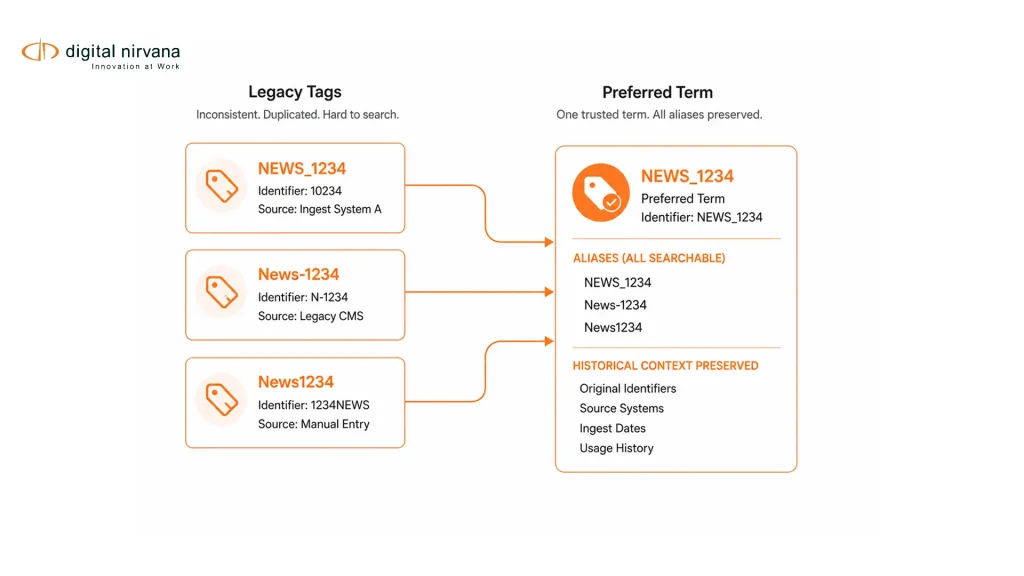
The archive exists. But it’s as if it doesn’t. Because metadata is sparse, inconsistent, and incomplete. A video is tagged “news clip” and nothing else. Another video has 500 words of metadata but it’s in the wrong format. Another is completely untagged because someone forgot to fill it out.
So 50,000 assets sit in storage. Costing money to maintain. Generating zero revenue. Creating zero operational value.
Then the news director learns about AI metadata tagging. They run a pilot: upload 1,000 archived videos to an AI system. In 48 hours, every single video has been automatically tagged with:
- Every person who appears in the video
- Every location mentioned
- Every topic discussed
- Time codes for specific moments
- Scene descriptions
- Searchable transcripts
The producers run a search: “senator climate policy interview 2018”. Suddenly they get results. Specific results. Usable results.
Within a week, those newly searchable assets are being repurposed in current stories. Within a month, they’re being licensed to other networks. Within a quarter, the archived content is generating revenue.
That’s when the news director realizes: they didn’t need to create new content. They needed to make invisible content visible.
The Metadata Gap (Why Archives Are Worthless Without It)
Here’s what most broadcast operations don’t know: 85% of their archive is essentially invisible.
That’s not an exaggeration. A Pew Research analysis of broadcast archives found that of 50,000+ assets in a typical operation, 85% have incomplete or unusable metadata. They’re indexed by name and date (because the system requires it), but not by content, topic, speaker, or any meaningful searchable attribute.
This creates an operational paradox: the asset physically exists, but operationally, it doesn’t. A producer looking for specific footage has to either:
- Manually search through thousands of files hoping to recognize one
- Ask colleagues if they remember where something is
- Re-shoot the footage instead of finding it
All three options waste time and money.
The root cause: manual metadata creation doesn’t scale. A human can watch a 5-minute video and tag it with speakers, locations, and topics. That takes 15-20 minutes. For a newsroom producing 50 videos per week, that’s 12-16 hours of tagging work. Per week. Forever.
After a few weeks, the tagging process gets cut. “We’ll do it later.” Later never comes. And suddenly you have 200 untagged videos.
This is why broadcast archives are simultaneously the most valuable and most worthless asset a newsroom owns. Valuable in potential. Worthless in practice.
What AI Can Extract From Video (The Metadata Revolution)
AI metadata tagging works differently than manual tagging. Instead of a human watching video and deciding what to tag, AI automatically extracts meaningful information from the content itself.
Here’s what modern AI can identify:
Visual Understanding:
- Every person visible in the video (with face recognition identifying who they are if trained)
- Every location (indoor/outdoor, city/rural, identifiable landmarks)
- Objects in scenes (vehicle types, weapons, animals, weather conditions)
- On-screen text (graphics, captions, signs, documents)
- Scene types (office, street, courtroom, stadium, interview setup)
Audio Understanding:
- Every speaker and what they’re saying (transcription)
- Music and sound effects (what’s playing, for how long)
- Emotional tone (is the speaker angry, excited, confused, somber?)
- Topics being discussed (extracted from speech)
Temporal Understanding:
- Time-coded moments (when specific events happen in the video)
- Scene changes and transitions
- Pacing and rhythm (fast-cut action vs. slow dialogue)
- Duration of specific elements (how long is the interview, how long is b-roll)
Content Understanding:
- Topics and themes
- People and their roles
- Events and contexts
- Related content (this interview is related to this story is related to this archived segment)
All of this gets extracted automatically. No human sits and watches the video. The AI does it in minutes.
The Scale Problem (Why Manual Tagging Is Dead)
Here’s the operational math that kills manual metadata tagging:
A newsroom has 10,000 hours of archived video. At 15 minutes of tagging per hour of video, that’s 2,500 hours of work. Assuming one person doing 8 hours a day, that’s 312 days of work. Over a year, that’s a dedicated employee doing nothing but metadata tagging.
And that’s just the backlog. Every week, they’re creating 50 new videos that also need tagging. That’s another 12-16 hours per week of ongoing work.
So you need 1.3 full-time employees dedicated entirely to metadata. At $60K salary + benefits, that’s $80K+ per year just to keep up.
Meanwhile, your 10,000-hour archive is still only getting basic metadata. Not the rich, searchable metadata that would actually make it valuable.
This is why AI metadata tagging is revolutionary. The same 2,500 hours of tagging that would take a human a year? An AI does it in 48 hours. The same 12-16 hours of weekly tagging work? AI does it overnight.
And the metadata is richer, more consistent, and more searchable than anything a human would create.
How AI Metadata Works (The Technical Reality)
AI metadata tagging starts with machine vision: training algorithms on millions of images to recognize objects, people, scenes, and activities.
Modern systems use deep learning models trained on broadcast/news content, so they understand newsroom-specific contexts: interview setups, press conferences, breaking news scenarios, sports moments, weather events, etc.
The workflow:
- Ingest: Video uploaded to the system
- Analysis: AI watches the entire video, extracting visual and audio features
- Transcription: Speech is transcribed and time-coded (speech becomes searchable)
- Entity Extraction: People, places, topics, organizations are identified
- Tagging: Automated tags are generated based on all extracted information
- Quality Review: A human reviews the tags (optional but recommended) for accuracy
- Indexing: Tags are indexed for search (now the video is discoverable)
The result: a 60-minute broadcast is fully tagged with 500+ metadata points in about 5 minutes. Without human intervention.
Real Broadcast Example: Archive Monetization
The Scenario: A sports network has 20 years of archived sports footage. Every major game, every highlight, every interview. The archive is worth millions in licensing to international broadcasters, streaming services, and fan content creators.
But it’s completely unsearchable. “Find all footage of the quarterback throwing a game-winning touchdown” requires someone to manually review thousands of hours.
With AI metadata tagging:
- Every play is automatically categorized (touchdown, field goal, interception, sack, etc.)
- Every player is identified by uniform number and position
- Every moment is time-coded
- Every significant play is flagged
Now the search “quarterbacks throwing touchdowns 2015-2020” returns specific moments across dozens of games. Licensing teams can instantly provide curated highlight packages. Revenue that was invisible becomes tangible.
Within the first year, newly monetized archived footage generates $500K+ in additional licensing revenue. That pays for the AI metadata system 10 times over.
The Metadata Enrichment Problem (Accuracy Matters)
Here’s where AI metadata tagging has a catch: accuracy isn’t always perfect.
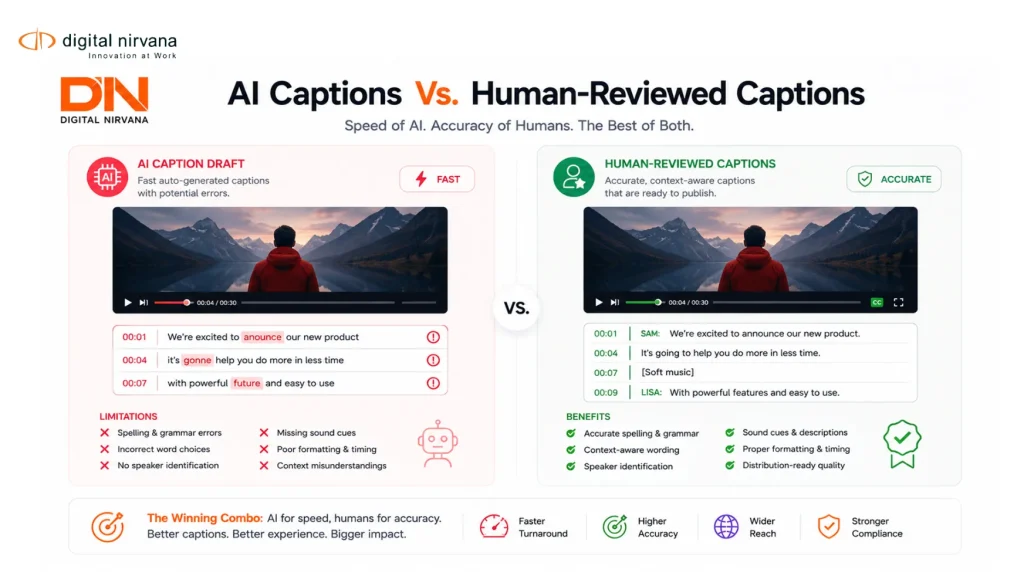
AI might identify someone in a video, but be wrong 15% of the time. It might tag a topic as “finance” when it’s actually “economics” (technically close, but operationally different). It might miss subtle context that a human editor would catch immediately.
This is why human review matters. Not for every tag (that would destroy the efficiency gain), but for critical tags.
A sports network running AI tagging might accept auto-generated tags for “game type,” “score,” and “length.” But they’ll have a human verify player identification (because incorrect player tags break revenue models).
A news operation might accept AI tagging for speakers, locations, and topics. But they’ll have a human verify if sensitive content was correctly flagged (because mislabeling can create compliance issues).
Media Enrichment services provide this human layer: a specialist reviews AI-generated metadata and corrects errors before the tags go into production.
The model: AI does 95% of the work fast. Humans verify the 5% that matters.
How Digital Nirvana Powers Metadata Tagging
This is where broadcast metadata tagging becomes enterprise-grade:
MediaServicesIQ provides the AI core: facial recognition, scene detection, object identification, audio analysis, and topic extraction. The system watches video and automatically extracts everything there is to know.
TranceIQ adds transcription: every word spoken is transcribed and time-coded. Search “senator says climate policy” and the AI jumps to the exact moment in the video.
MetadataIQ indexes everything: AI-generated metadata is organized, searchable, and connected to your MAM system. Videos become discoverable across your entire archive.
Media Enrichment validates the metadata: A human specialist reviews tags for accuracy, correcting errors and ensuring sensitive content is properly flagged.
Cloud Engineering handles the scale: Processing thousands of hours of video, storing metadata securely, delivering results at speed.
Together, these capabilities transform archives from storage cost to revenue asset.
Key Takeaways
- 85% of broadcast archives are operationally invisible due to incomplete metadata. AI tagging makes them visible.
- Manual metadata creation doesn’t scale. One full-time employee per 10,000 hours of content. AI handles the same volume overnight.
- AI extracts rich metadata automatically: speakers, locations, topics, emotions, objects, scenes, time codes. All without human effort.
- Searchable archives unlock revenue. Sports networks, news operations, and broadcasters monetize previously unusable content through licensing and syndication.
- Accuracy requires human review for critical tags. AI does bulk tagging. Humans verify sensitive/important tags.
- Archive metadata scales with transcription. Spoken words become searchable, enabling full-text search across your entire video library.
- ROI is fast. Archive monetization typically recovers AI metadata costs within months, then generates ongoing revenue.
Ready to Unlock Your Archive?
Your broadcast archive is currently an invisible asset. Thousands of hours of content, zero operational value. That changes when metadata makes it searchable, discoverable, and monetizable.
Explore MediaServicesIQ to see how AI metadata tagging transforms archives into competitive advantages and revenue streams.
Discover MetadataIQ for searchable metadata integrated with your existing MAM system.
Learn about Media Enrichment QA for human verification of critical metadata.
Let’s talk about your archive’s potential.