It’s 11:47 PM. A regional affiliate’s master control operator gets a call from the network: a caption dropout during prime time, and a viewer complaint has already landed on the FCC’s desk. Nobody on shift noticed, because nobody was watching that channel in real time. This is the moment every broadcast engineering team dreads, and it’s also the exact scenario a modern digital broadcast monitoring system is built to prevent.
If you run master control, engineering operations, or compliance for a station group, this scenario probably sounds familiar. The good news is that the technology to catch these issues before they become incidents already exists, and it doesn’t require another manual review shift.
The Core Problem: Watching Everything, All the Time, Isn’t Human-Scale
Broadcast operations have grown far faster than the teams that monitor them. Multi-channel station groups, OTT simulcasts, and regional splits mean a single engineer might be responsible for a dozen feeds at once. Manual spot-checking simply cannot keep pace with that volume.
Every missed signal carries real cost. A dropped caption stream risks an FCC complaint. A loudness spike sends viewers reaching for the remote. A black frame or frozen signal during a live sports broadcast erodes viewer trust in seconds. None of these problems announce themselves loudly enough for a human watching six monitors to catch every time.
The pain isn’t a lack of effort from engineering teams. It’s that traditional monitoring approaches were designed for a smaller, simpler broadcast footprint than the one most teams operate today.
Market Context: Compliance Pressure Isn’t Slowing Down
Regulatory scrutiny around broadcast accessibility and signal quality continues to tighten. The FCC’s closed captioning rules and the CALM Act’s loudness requirements remain active enforcement priorities, and Ofcom’s access services code sets similarly strict expectations for UK broadcasters. Non-compliance isn’t just a fine risk; it’s a reputational one, especially when viewer complaints go public on social media before they ever reach a regulator.
At the same time, channel counts keep growing. FAST channels, regional splits, and OTT simulcasts have multiplied the number of feeds broadcasters must keep an eye on, without a proportional increase in engineering headcount. That gap is exactly where a proper monitoring platform earns its budget line.
Traditional Solutions and Their Gaps
Most legacy approaches to broadcast monitoring fall into one of three categories, and each has a ceiling.
Manual spot-checking. An operator tunes into a channel periodically, watches for a few minutes, and moves on. This catches obvious failures but misses anything intermittent, and it doesn’t scale past a handful of channels.
Standalone hardware probes. These are reliable for signal-level issues like black frame or silence detection, but they’re often siloed from caption, loudness, and content-level monitoring, forcing engineers to check multiple dashboards to get a full picture.
Legacy compliance loggers. Many station groups still run recording systems built a decade ago. They archive footage for proof of performance, but they don’t proactively flag issues, meaning problems are only discovered after a complaint already exists.
None of these approaches connect signal monitoring, compliance logging, and content-level insight into a single, searchable system. That disconnection is the real gap.
How a Modern Digital Broadcast Monitoring System Works
A modern platform brings signal monitoring, quality-of-experience (QoE) tracking, closed caption verification, loudness compliance, and proof-of-performance logging into one connected workflow, rather than treating them as separate tools.
At its core, the system continuously ingests live feeds, checks them against defined thresholds (audio loudness, caption presence, black frame, freeze frame, silence), and raises alerts the moment something drifts out of spec. Everything is timestamped and archived, so when a dispute or complaint does arrive, engineering teams can pull exact proof of what aired, and when.
Platforms like MonitorIQ are built around this exact principle: give engineering, compliance, and ad operations teams one dashboard instead of five disconnected tools, with alerts that reach the right person before a viewer complaint does.
Real-World Workflow: A Day in Master Control
Picture a station group running 14 regional feeds. Instead of an operator manually cycling through channels every hour, the monitoring platform watches all 14 continuously and flags anomalies as they happen.
At 6:15 AM, the system detects a loudness spike on a local news feed during a commercial break and sends an alert to the on-duty engineer within seconds, well before viewers start calling in. At 9:30 AM, it flags a missing closed caption stream on a syndicated program, giving the compliance team time to correct it before the next scheduled airing.
By lunchtime, the ad operations team pulls a proof-of-performance report to resolve a billing dispute with an advertiser, using exact timestamps from the same system rather than digging through hours of raw archive footage. That single workflow, spanning engineering, compliance, and sales, is what separates a connected monitoring platform from a pile of disconnected tools.
Measurable Impact: What Teams Actually Gain
Broadcast teams that move from manual or siloed monitoring to a connected system typically see impact in three areas: faster issue detection, reduced compliance exposure, and less time spent manually reconciling proof-of-performance requests.
Instead of discovering a caption or loudness failure through a viewer complaint hours later, teams get near-real-time alerts, often cutting detection time from hours to minutes. Ad reconciliation, which used to mean manually scrubbing through archived footage, becomes a search query against timestamped, tagged recordings. That time savings compounds quickly across a multi-channel operation.
Implementation Considerations
Rolling out a monitoring platform isn’t a rip-and-replace project. Most broadcast engineering teams already run signal chains built around vendors like Grass Valley, Avid, or other MAM systems, and a good monitoring solution needs to integrate with that existing infrastructure rather than force a redesign.
Before implementation, engineering leads should map out which channels need continuous monitoring versus periodic checks, define loudness and caption thresholds specific to their regulatory region (FCC versus Ofcom requirements differ), and decide who receives which alerts. Teams that skip this planning step often end up with alert fatigue, where too many low-priority notifications drown out the ones that matter.
Key Capabilities to Prioritize When Evaluating a Platform
Not every monitoring tool covers the same ground. When evaluating options, broadcast engineering and compliance leaders should look for:
- Continuous, multi-channel signal monitoring (black frame, freeze frame, silence detection)
- Closed caption presence and accuracy verification
- Loudness monitoring aligned to CALM Act and regional standards
- Searchable, timestamped proof-of-performance archives
- Remote monitoring support for distributed or multi-site operations
- Integration with existing MAM/DAM and production systems
- Configurable alerting so the right team gets the right notification
A platform that checks all of these boxes reduces the number of separate tools an engineering team has to babysit, which is often the highest hidden cost of legacy monitoring setups.
Common Objections and Counterarguments
“We already have hardware probes for signal monitoring.” Signal-level probes are useful, but they typically don’t cover caption verification, loudness compliance, or searchable proof of performance in one place. Pairing hardware detection with a connected software layer closes that gap without discarding existing infrastructure.
“Manual monitoring has worked fine so far.” It often works until a channel count grows, a compliance audit happens, or a high-profile complaint surfaces. The risk isn’t visible until it becomes expensive.
“We’re worried about false alerts overwhelming the team.” This is a real risk with poorly configured systems. The fix is proper threshold tuning during implementation, not avoiding monitoring altogether.
Success Metrics and KPIs to Track
| Metric | What It Tells You |
| Mean time to detect (MTTD) signal or compliance issues | How quickly your team catches problems before viewers do |
| Number of caption/loudness compliance incidents per quarter | Whether monitoring is reducing regulatory exposure |
| Time spent on manual proof-of-performance requests | Operational efficiency gains |
| Alert-to-resolution time | How well alerts route to the right team member |
| Channel coverage percentage | Whether monitoring scales with your channel footprint |
Tracking these consistently gives engineering leadership a clear before-and-after picture when justifying the investment to finance or executive teams.
How Digital Nirvana Approaches Broadcast Monitoring
Digital Nirvana built MonitorIQ specifically around the problem broadcast engineering teams face every day: too many channels, not enough eyes, and compliance risk that only becomes visible after something goes wrong. The platform brings signal monitoring, QoE, loudness, closed caption verification, and proof-of-performance logging into a single, searchable system, so teams stop juggling five dashboards to answer one question.
For station groups also managing metadata and archive search challenges, MetadataIQ extends that same searchability to content discovery, while TranceIQ and Media Enrichment support caption accuracy and multilingual delivery needs that often surface alongside compliance monitoring conversations. Teams exploring how AI-assisted microservices like scene detection or automated summaries fit into their broader operations can also review MediaServicesIQ.
Why This Matters for Your Broadcast Operation
Broadcast compliance and monitoring aren’t isolated engineering concerns anymore. They touch ad sales (through proof-of-performance disputes), legal (through accessibility obligations), and viewer trust (through signal quality). A connected monitoring approach, backed by the kind of human-in-the-loop review Digital Nirvana applies across its Managed AI services, gives every one of those stakeholders the visibility they need from a single source of truth. Real customer outcomes across broadcast, sports, and news operations are documented in Digital Nirvana’s success stories, showing how this approach plays out in live production environments.
Conclusion
A digital broadcast monitoring system isn’t a nice-to-have anymore; it’s the infrastructure that protects your compliance standing, your ad revenue, and your viewers’ trust, all at once. As channel counts grow and regulatory scrutiny holds steady, the gap between manual monitoring and a connected platform only widens. Closing that gap now, before an incident forces the issue, is the more comfortable path for any broadcast engineering team.
Key Takeaways
- Manual spot-checking and siloed hardware probes can’t keep pace with today’s multi-channel broadcast operations.
- FCC and Ofcom compliance requirements around captions and loudness remain active enforcement priorities.
- A connected monitoring platform combines signal, caption, loudness, and proof-of-performance data into one searchable system.
- Faster detection means fewer viewer complaints, lower compliance risk, and less time spent on manual reconciliation.
- Successful implementation requires clear threshold planning and alert configuration to avoid alert fatigue.
- Track MTTD, incident counts, and alert-to-resolution time to measure ongoing impact.
FAQ
What is a digital broadcast monitoring system? It’s a platform that continuously checks live broadcast feeds for signal, caption, and loudness issues, and archives that data for compliance and proof-of-performance purposes.
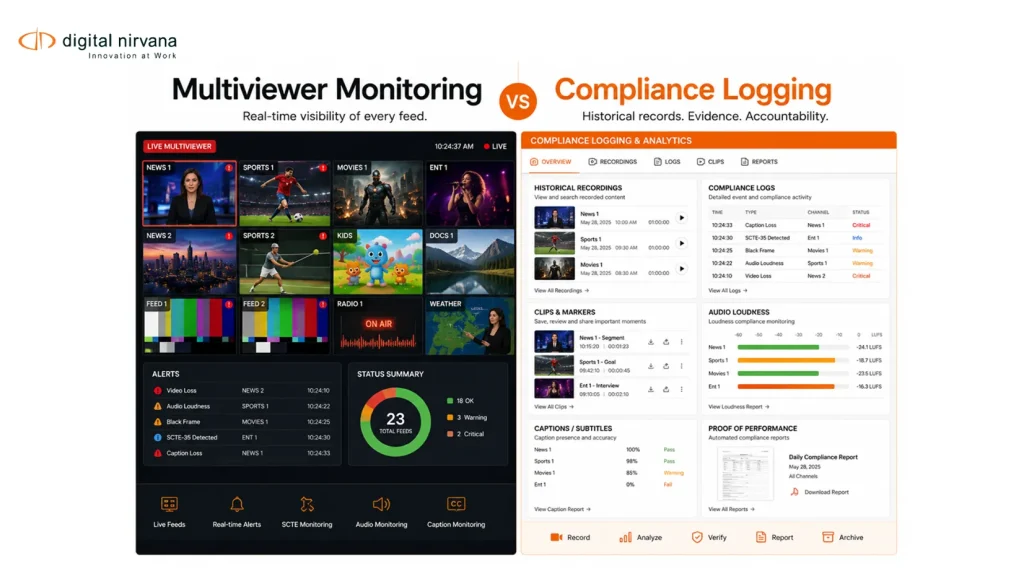
How is broadcast monitoring different from compliance logging? Monitoring focuses on real-time detection of signal and quality issues, while compliance logging focuses on archiving that data for audits, disputes, and regulatory proof.
Do monitoring platforms replace existing hardware probes? No. Most platforms integrate with existing signal chains and hardware, adding a connected software layer for caption, loudness, and searchable proof-of-performance tracking rather than replacing infrastructure outright.