In 2024, a broadcast newsroom had this structure: journalists reported stories. Editors assigned coverage. Photographers captured footage. Post-production teams edited. Graphics teams created visuals. Distribution teams handled delivery.
Eight specialized teams. Clear handoffs. Predictable workflow.
By October 2025, that structure was obsolete.
A single journalist in the same newsroom now handled reporting, AI-assisted video editing, automated caption generation, graphics creation (via AI templates), and multi-platform distribution (auto-formatted by AI to platform specs).
The workflow collapsed from eight steps to three: report, AI enhance, distribute.
The cost structure collapsed too. Labor requirements dropped 40%. Time to publish dropped from hours to minutes. Quality, paradoxically, improved (AI doesn’t miss details, doesn’t get tired).
This wasn’t one newsroom experimenting. By mid-2026, this was the dominant workflow across major markets.
And most industry observers were still writing think-pieces about whether AI would impact media.
It already had.
The Three Seismic Shifts (And Why The Old Model Broke)
The media landscape didn’t change incrementally. It shifted on three axes simultaneously, and the old model couldn’t survive all three at once.
Shift #1: Content Creation Became Collaborative (Humans + AI)
In the old model, a human created content, period. AI wasn’t involved in the creative process. It was post-production tooling at best.
In the new model, AI augments human creativity from the beginning. A journalist writes a story. AI suggests data visualization options. A photographer captures images. AI auto-edits them in real-time. An editor assembles a package. AI generates captions, graphics, and social clips.
Humans decide. AI executes. Human + AI delivers in 1/4 the time.
This destroyed the labor-intensive production model. Newsrooms that maintained eight specialized teams while competitors were running three suddenly had a cost problem. Economics forced consolidation.
Shift #2: Distribution Became Automated (Not Manual)
Old model: Content gets published to one platform (the website). Distribution to other platforms is manual work (posting to social, uploading to YouTube, etc.).
New model: Content gets uploaded once. AI automatically formats it for every platform: vertical video for TikTok, landscape for YouTube, square for Instagram, text-based for LinkedIn. Platform-specific captions, thumbnails, and metadata generated automatically.
Manual multi-platform distribution went from 2 hours of work to 15 minutes of AI processing.
Newsrooms maintaining dedicated social media teams while competitors automated distribution had a productivity problem. Economics forced consolidation.
Shift #3: Personalization Became Standard (Not Premium)
Old model: Everyone gets the same homepage. Maybe dynamic headlines, but that’s it. Personalization requires heavy engineering and infrastructure.
New model: AI learns viewer preferences. Every viewer sees different content order. Stories matched to interests. Topics they care about surfaced first. Engagement improved 30-50% on personalized feeds vs. static homepages.
Newsrooms maintaining one-size-fits-all distribution while competitors offered personalization had an engagement problem. Audience shifted. Revenue followed.
All three shifts happened in parallel. The old model couldn’t survive one. It definitely couldn’t survive all three.
What Changed In Newsrooms (The Real Impact)
Here’s what actually transformed:
Workflow changed: Instead of specialized teams passing work, one person (with AI assist) handles full production cycle. Less handoff. Less loss in translation. Faster delivery.
Cost structure changed: A $500K/year salary divided among eight people becomes AI software ($50K/year) supporting three people. Same output. Dramatically different cost.
Quality changed: Consistently high (AI doesn’t have bad days). No typos in captions (AI doesn’t get careless). Metadata is complete (AI doesn’t skip steps). Graphics are optimized (AI tries thousands of variations instantly).
Speed changed: Breaking news goes from 30 minutes to air to 5 minutes to air. Sports highlights go from 2-3 hours of editing to 15 minutes of AI processing.
Reach changed: One story published to 20 platforms instead of 2 (web + Facebook). Audience grew without staff growing.
Collectively, these changes broke the economics of the old model. Newsrooms had to adapt or become uncompetitive.
The New Media Landscape (Who Wins, Who Doesn’t)
AI didn’t destroy media. It restructured the industry.
Winners: Fast-moving organizations that automated ruthlessly. By 2026, the most successful newsrooms had AI-first workflows. They were leaner, faster, reaching bigger audiences with smaller teams.
Losers: Legacy organizations that tried to maintain the old workflow while adding AI on top. They had the cost of both systems with the efficiency of neither.
Disruption zone: Mid-tier organizations that faced a choice: automate hard and cut staff, or maintain expensive hybrid workflows. Many chose hybrid as a transition. Some are still stuck there.
The media landscape in 2026 looks nothing like 2024 because the economic incentives forced transformation. Newsrooms that resisted automation lost audience to newsrooms that embraced it. Revenue followed audience. Economic pressure forced change.
It’s the most dramatic industry restructuring in 30 years. And it happened in 18 months.
How Digital Nirvana Powered The Shift
This transformation wasn’t accidental. It required specific technology stack:
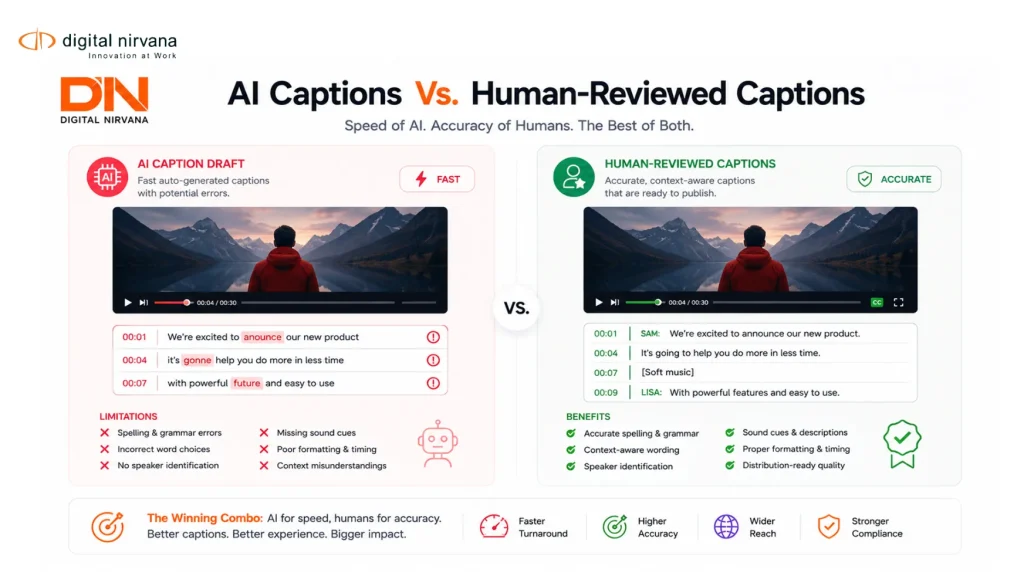
TranceIQ provided the foundation: auto-transcription and caption generation. Every broadcast now has captions and transcripts automatically. No manual captioner required.
MediaServicesIQ added AI enrichment: video analysis, content tagging, graphics generation, social clip creation. One piece of source content becomes multiple optimized assets.
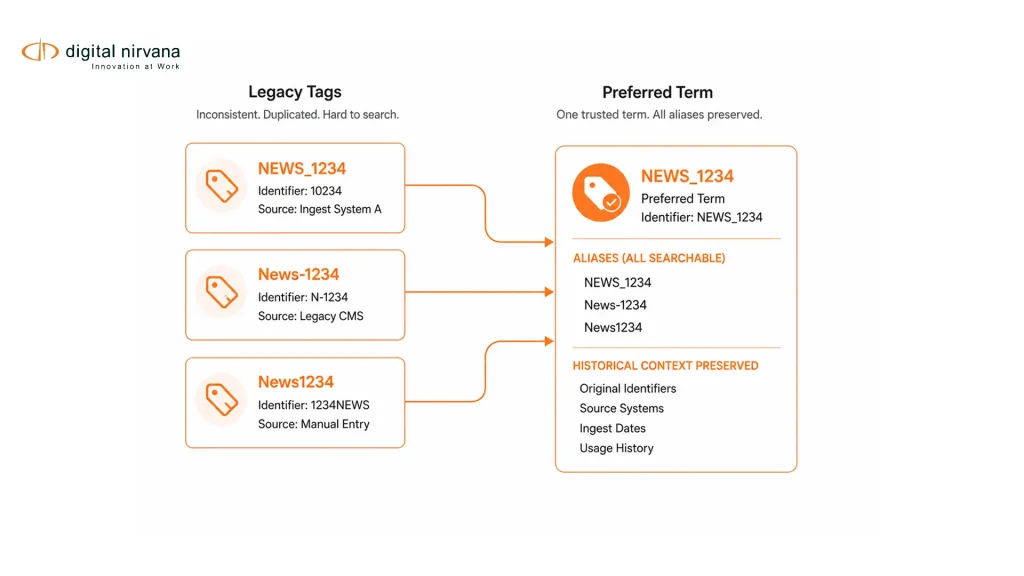
MetadataIQ made everything discoverable: automatic tagging, searchable archives, content recommendations. Archive became asset library instead of storage cost.
Media Enrichment validated quality: human review layer ensured AI-generated content met editorial standards. Automation with quality control.
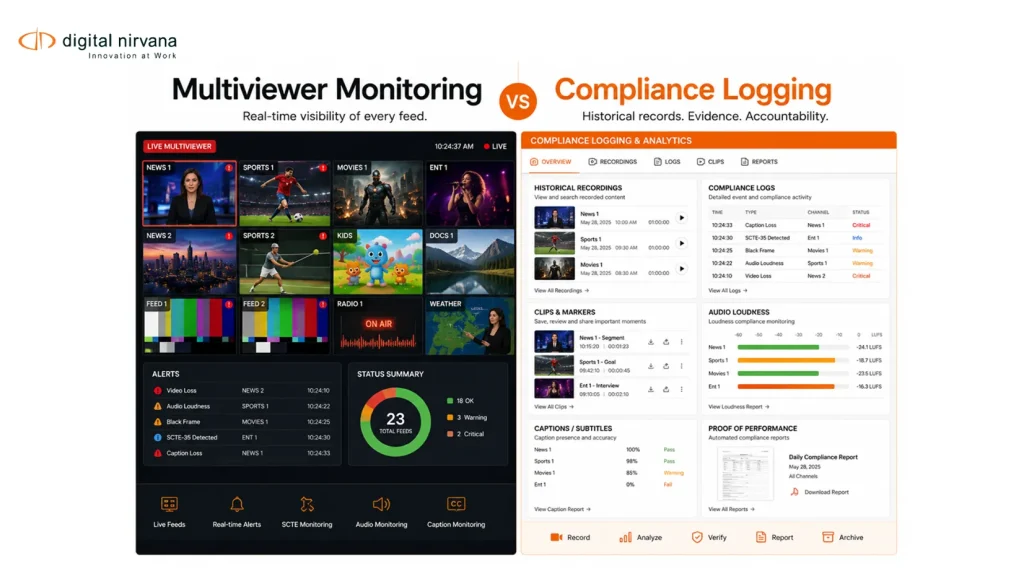
MonitorIQ ensured compliance: real-time monitoring meant AI-published content never violated standards. Automated checks replaced manual QC.
Cloud Engineering handled the scale: processing hundreds of hours per day, managing archival, enabling real-time distribution.
Together, these capabilities enabled the newsroom transformation. Not in theory. In practice.
What’s Next (The Forecast)
AI will continue reshaping media in 2027 and beyond:
Personalization deepens: Every user gets custom experience. No two people see the same homepage.
Real-time reporting: AI watches social feeds, identifies breaking stories, auto-generates initial coverage within seconds. Journalists add depth.
Global hyperlocal: AI can now deliver hyperlocal news to neighborhood level with global production standards. 100 neighborhoods, one staff, personalized coverage for each.
Video as default: Short-form video production becomes so easy (and monetizes so well) that it becomes default format, not premium.
AI creators: Full automated content creation for less important stories (school board meetings, weather, sports stats). Humans focus on investigation and analysis.
The landscape will keep shifting. Organizations that embrace it thrive. Those that resist get left behind.
Key Takeaways
- The media landscape fundamentally changed in 2025-2026. Not incrementally. Seismically.
- Newsrooms restructured around AI workflows. Eight specialized teams became three generalists + AI. Economics forced it.
- Multi-platform distribution became automatic. One upload. AI formats for every platform.
- Speed improved 6-8x. Breaking news cycles compressed from 30 minutes to 5 minutes.
- Cost structure collapsed. AI-driven workflows cost 40-60% less than traditional approaches.
- Quality became consistent. AI doesn’t have off days. Editorial standards are systematized.
- Archive became asset library. Searchable, tagged content generates revenue through licensing and syndication.
Ready To Transform Your Media Workflow?
The landscape has shifted. Organizations that embraced AI in 2025-2026 are thriving. The rest are struggling with cost and competitiveness.
Explore MediaServicesIQ to see how AI augments your production workflow.
Discover TranceIQ for automated caption generation and multi-platform distribution.
Learn about MetadataIQ for searchable archives and content discovery.
Let’s talk about your media transformation strategy.