It’s 2 AM. You’re watching a thriller in bed. Your partner is asleep. The sound is off. You’ve got captions on because you can’t hear anything, but you still want to watch.
A tense scene. The detective is examining evidence at a crime scene. On screen, ambient music swells. Tension building. The music is doing something important to the narrative.
You’re waiting for captions to tell you what’s happening. But depending on what kind of captions are on your screen, you might see completely different information.
Maybe you see “[Dramatic orchestral music intensifies]” because the platform used Closed Captions.
Maybe you see nothing about the music at all because the platform used SDH Subtitles.
Same content. Same viewer. Different caption types. Completely different experience.
This confusion between Closed Captions and SDH Subtitles is one of the most misunderstood problems in content delivery, and it’s silently affecting how millions of viewers experience content.
The History That Created the Confusion
Let’s go back to the beginning.
In the 1980s, closed captions were invented specifically for deaf and hard-of-hearing viewers. “Closed” meant they could be turned on or off (as opposed to “open” captions that are burned into the video permanently). The purpose was clear: provide deaf viewers with complete information about what’s being broadcast, including dialogue and all audio information.
Closed captions had to include everything. Every word of dialogue. Every sound effect. Every music cue. Every emotional audio context. Because without sound, deaf viewers needed text to understand everything that was happening.
Then, in the 1990s, something unexpected happened.
Hearing people started watching content with sound off. Not because they couldn’t hear. Because they were in situations where sound wasn’t possible. Watching on planes. In offices. In coffee shops. Late at night without disturbing others.
These hearing viewers needed captions too, but not for the same reason. They could hear dialogue if sound was on. They needed captions because they couldn’t use sound.
This created a second caption type: SDH, or Subtitles for the Deaf and Hard of Hearing.
In theory, SDH and CC are similar. Both are visible captions that include more than just dialogue. But in practice, they’re often treated differently.
And that difference matters way more than anyone admits.
Why the Difference Actually Matters (And Why Nobody Explains It Right)
Let’s be specific about what’s different, because most resources gloss over this.
Closed Captions (CC) are designed to provide complete audio information for people who cannot hear. That means:
Every word of dialogue, exactly as spoken. Every sound effect (door slam, phone ringing, glass breaking). Every music cue (and often a description of the music’s emotional quality). Background noises that are important to context. Speaker identification, especially when multiple people are talking. Even silence when silence is narratively important.
The goal is: if you turned the volume all the way down, someone reading captions would understand everything that’s happening.
SDH Subtitles are technically for deaf and hard-of-hearing viewers, but they’re often formatted differently. Sometimes:
Every word of dialogue is included. Major sound effects are included, but maybe not every single one. Music might be described more minimally or not at all. The format might be different (different positioning, different timing rules). Speaker identification might be less explicit.
The theory is: SDH is for people who are deaf but watching in an environment where they can see text clearly. So some formatting can be different.
In practice, the distinction is messy. Most platforms just use one or the other inconsistently. Some use them interchangeably. Some don’t understand the difference at all.
But here’s where it gets critical: if you’re a deaf viewer watching with SDH captions instead of CC, you might miss important audio information. If you’re a hearing person watching with full CC instead of SDH, the captions might feel cluttered or overly detailed.
The wrong caption type for the wrong viewer creates a degraded experience.
Learn how comprehensive caption standards ensure both deaf and hearing audiences get the right experience.
The Story That Reveals Why This Matters
A streaming platform was getting complaints from deaf viewers about one specific show. The show had captions. The captions seemed fine. But deaf viewers were saying they were missing information.
The platform investigated. They watched the show with the captions on. Everything seemed to be there.
Then they looked closer at the caption files. The platform had been using SDH subtitles for that show instead of full Closed Captions. The difference: the platform wasn’t including descriptions of background music or ambient sound effects.
The show was a drama with a lot of emotional audio context. The music was telling part of the story. Deaf viewers needed to know what the music was doing to understand the emotional beats.
With SDH, they were missing that. They could follow the dialogue fine, but they were losing narrative context.
The platform realized they’d made an assumption: deaf viewers just need dialogue captions. In reality, deaf viewers need complete audio information, which includes music and sound effects.
It was a small mistake, but it affected the entire viewing experience for an entire population of viewers.
The Technical Difference That Nobody Talks About
Here’s where it gets genuinely complicated.
Closed Captions have specific technical requirements. They have to include certain formatting to indicate speaker changes, sound effects, and music cues. Different broadcasters use different symbols:
[Music playing] vs. (Music) vs. music
Some use detailed descriptions. Some use minimal descriptions. Some use industry-standard formatting.
SDH subtitles sometimes use less standardized formatting. They might be simpler. They might not follow the same conventions.
This matters because different platforms have different requirements for caption formatting. Netflix wants captions formatted one way. Amazon wants them formatted differently. Hulu wants yet another format.
If you’re creating captions for multiple platforms, you need to know: does Netflix want full CC or can SDH work? Does Amazon require full audio descriptions? Does Hulu have specific formatting rules?
Get this wrong, and your captions get rejected by the platform. Or they get accepted but display incorrectly. Or they display correctly but don’t meet accessibility standards.
Understand platform-specific caption conformance standards for Netflix, Amazon, Hulu, and streaming services.
Why This Confusion Is Actually Expensive
Let’s talk about what goes wrong when platforms don’t understand the difference between CC and SDH.
A production company submits captions to a streaming platform. The platform checks them. The captions seem complete. They get approved.
Six months later, accessibility advocates file a complaint. The platform’s captions don’t meet FCC standards for Closed Captions. The platform has to redo all the captions, bring them up to standard, and resubmit.
That’s a $20,000-$50,000 project that could have been avoided if someone understood the difference between CC and SDH from the start.
Or worse: a platform launches international content with SDH subtitles when they should have used CC. Deaf viewers complain. Accessibility organizations file formal complaints. The platform faces potential FCC fines or license challenges.
The cost goes from $30,000 to fix it proactively to $100,000+ to defend it and fix it reactively.
This is happening right now at streaming platforms that don’t have clear caption standards.
The Workflow That Gets This Right
The teams handling this correctly do something simple: they know what caption type they need before they start.
They ask:
Is this content for broadcast television (requires CC)? Is this for streaming (could be CC or SDH depending on platform)? Is this for international audiences (needs comprehensive audio descriptions)? What do our accessibility standards require?
Then they commission captions to that specific standard. CC if they need full audio information. SDH if that’s appropriate.
They also implement a quality review. Not just “do the captions exist?” but “do the captions meet our specific standard?”
This requires expertise. Someone who understands accessibility standards. Someone who knows platform requirements. Someone who can review captions and confirm they meet standards.
Most platforms don’t have this. They have caption coordinators, but not people trained in accessibility standards.
This is where mistakes happen.
The Moment One Platform Finally Got It Right
A major streaming platform realized they had no consistent caption standards. Some shows had full Closed Captions. Some had SDH. Some had neither, just dialogue subtitles.
Deaf viewers were getting inconsistent experiences. The platform’s reputation with accessibility communities was suffering.
They made a decision: all original content would have full Closed Captions meeting FCC standards. Acquired content would be evaluated: if it didn’t meet CC standards, the platform would invest in upgrading it.
This was expensive. Re-captioning a single season of a show to CC standards could cost $15,000-$30,000.
But the platform realized the cost of not doing it was higher. FCC complaints. Accessibility lawsuits. Brand damage. Subscriber loss.
Within two years, they’d recaptioned their entire library to consistent standards. Deaf viewers suddenly had a consistent experience across all platform content. Accessibility advocates stopped filing complaints.
More surprisingly, other viewers started noticing the improved captions. Even hearing viewers watching with sound on were using the captions more because they were higher quality and more consistent.
The investment in proper caption standards didn’t just help deaf viewers. It improved the viewing experience across the board.
Why Your Platform Probably Has This Problem
If your platform doesn’t have clearly defined caption standards, you’ve got a problem.
Are you using CC or SDH? Do you know the difference? Can you explain to creators what you require?
If not, you’re probably:
Getting rejected captions from creators because they don’t know what standard you want. Accepting captions that don’t meet your own standards because no one reviewed them properly. Getting complaints from deaf viewers because your captions are inconsistent. Potentially facing regulatory issues because you’re not meeting FCC accessibility standards.
The fix is simple: establish clear standards, communicate them to creators, implement quality review, and stick to them.
Most platforms don’t do this because it seems like overhead. Until a compliance issue or accessibility lawsuit makes it clear that overhead would have been cheaper than the alternative.
Learn how comprehensive caption compliance and quality assurance prevent regulatory issues and improve viewer experience.
The Accessibility Issue That Nobody Wants to Admit
Here’s the uncomfortable truth: many streaming platforms are broadcasting captions that don’t meet FCC accessibility standards for Closed Captions.
They’re not doing it maliciously. They just don’t understand the difference between CC and SDH, or they’re cutting corners to save money.
The FCC doesn’t aggressively enforce CC standards for streaming (they do for broadcast), but they could. And as streaming becomes more dominant, pressure to enforce standards is increasing.
A platform that gets audited might discover that captions they thought were compliant actually aren’t. The cost to fix it is enormous.
This is a landmine that most platforms are walking on without realizing it.
The Numbers That Should Scare Platform Executives
Let’s talk about cost avoidance.
Getting captions right from the start: $0.50-$1.50 per minute depending on quality level.
Getting captions wrong and having to redo them: $2.00-$3.00 per minute because you’re doing the work twice.
FCC fine for non-compliant captions: $25,000-$350,000 per violation.
Accessibility lawsuit from disability advocates: $100,000-$500,000+ in legal fees, regardless of outcome.
Brand damage from accessibility community backlash: Immeasurable, but real.
The ROI on getting caption standards right from the start is overwhelming.
Why Digital Nirvana Is the Standard for CC and SDH Caption Compliance
Caption compliance sounds straightforward until you realize that most platforms don’t have clear standards for what kind of captions they actually need. The confusion between Closed Captions and SDH Subtitles, combined with platform-specific formatting requirements, creates a compliance minefield that most content teams navigate by accident rather than design. What you actually need is a systematic approach to caption type specification, creation, quality assurance, and platform delivery that ensures every piece of content meets both accessibility standards and platform requirements.
TranceIQ delivers caption workflows with explicit CC and SDH support, allowing platforms to specify exactly which standard they require. The system creates captions to specific accessibility standards (FCC CC requirements, international standards, platform-specific requirements) with built-in quality checks to ensure compliance. When content needs to be Closed Captions meeting full audio description standards, TranceIQ ensures every sound effect, music cue, and emotional audio context gets captured. When SDH is appropriate, the system delivers captions formatted to those specifications. Media Enrichment provides expert-level caption review and compliance validation for high-stakes content where accessibility compliance is non-negotiable. Additionally, AI-powered quality detection through MediaServicesIQ can automatically flag caption completeness issues, timing problems, and formatting errors that might not meet accessibility standards before content goes live.
For streaming platforms managing large caption libraries with mixed quality standards, establishing clear guidelines and audit trails becomes critical. MetadataIQ tracks caption type, compliance status, and accessibility standards so platforms can identify which content has proper CC, which has SDH, and which is missing required audio descriptions. This creates a comprehensive inventory of compliance status across your entire library. The result is predictable: FCC compliance becomes demonstrable. Deaf viewers get consistent, complete caption experiences across all platform content. Hearing viewers benefit from higher-quality captions that enhance comprehension. And your platform avoids the expensive mistake of discovering after launch that captions don’t meet the standards you thought they met.
FAQ: Everything You Need to Know About CC vs. SDH Captions
Q: Are Closed Captions and SDH the same thing?
They’re similar, but not identical. CC (Closed Captions) are specifically for deaf and hard of hearing viewers and must include all dialogue plus complete audio information. SDH (Subtitles for the Deaf and Hard of Hearing) are also for deaf viewers but sometimes have slightly different formatting or less detailed audio descriptions. In practice, the lines blur, but the distinction matters for compliance.
Q: What exactly needs to be in Closed Captions?
All dialogue, all sound effects, all music cues (with descriptions), background noises that are important to context, speaker identification, and sometimes notations about emotional quality of sounds. Essentially, everything a deaf viewer needs to understand what’s happening in the content.
Q: Do SDH captions need to include music descriptions?
It depends on the standard and the platform. Full CC always needs music descriptions. SDH sometimes includes them minimally or not at all. This is where confusion happens and mistakes get made.
Q: Is there an FCC standard that specifies CC vs. SDH?
The FCC requires broadcasters to use Closed Captions meeting specific accessibility standards. For streaming, standards are less prescriptive but moving toward CC requirements. Different countries have different standards (Ofcom in the UK, for example, has specific requirements).
Q: Which platforms require CC vs. SDH?
Netflix typically requires CC-level quality. Amazon has specific caption requirements. Hulu has different requirements. Each platform publishes caption guidelines that specify what they need. Most require full audio descriptions at minimum.
Q: Can we use SDH instead of CC to save costs?
Technically yes, but strategically no. If you’re serving deaf viewers, using SDH when you should use CC means those viewers are getting degraded captions. The cost savings is minimal compared to the accessibility impact.
Q: What happens if we submit captions that don’t meet platform requirements?
The platform rejects them. You have to redo them. This can delay content launch by weeks and cost $20,000-$50,000 in rework fees.
Q: Do international markets have different caption requirements?
Yes, significantly. The UK (Ofcom standards), Canada (AODA), Australia (accessible media), and other countries all have specific caption requirements. Content released in multiple territories needs to meet all applicable standards.
Q: How do we know what caption standard our content needs?
First, determine where the content will air (broadcast, streaming, international). Then research that territory’s accessibility standards. Check your platform’s specific requirements (Netflix has published guidelines, Amazon has published guidelines, etc.). Specify that standard when commissioning captions.
Q: What’s the cost difference between CC and SDH captions?
Often minimal. Both require transcription, timing, and speaker identification. The difference is in completeness of audio descriptions. For a $1.00 per minute SDH caption, CC might be $1.25-$1.50 per minute. The difference is small enough that most platforms now go with CC for everything.
Q: Can automatic captioning create compliant CC or SDH?
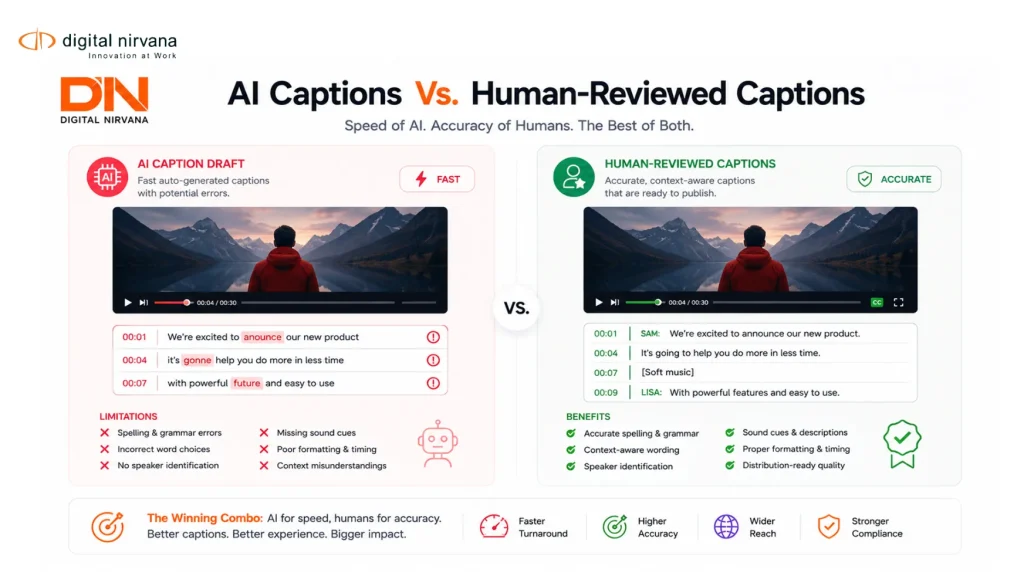
Auto-generated captions can create a base layer, but human review is almost always necessary to ensure accessibility compliance. Auto-captions catch 90%+ of dialogue but might miss sound effects, music cues, or context that’s important for deaf viewers.
Q: Who actually checks that our captions meet standards?
Ideally, someone trained in accessibility standards and platform requirements. In practice, many platforms don’t have dedicated review. This is where mistakes happen. Invest in proper caption review, not just caption generation.
Q: What happens if we get sued for non-compliant captions?
Disability rights organizations are increasingly filing lawsuits against platforms for caption non-compliance. Legal defense costs tens of thousands. Settlements often require platform to invest in caption improvements. Brand damage is real.
The Moment When Caption Standards Stop Being Optional
You’ve heard the distinctions. You probably realize your platform might not have clear caption standards. You might be worried that some of your content doesn’t meet accessibility requirements.
But knowing the problem and fixing it are different things.
The platforms getting this right aren’t just creating captions and hoping they meet standards. They’re establishing clear requirements, communicating those to creators, implementing quality review, and maintaining consistent standards across their entire library.
It’s not complicated. It just requires intentional design and follow-through.
Schedule a 20-minute consultation to audit your current caption standards and identify which of your content might not be meeting accessibility requirements. No judgment. No sales pitch. Just clarity on your compliance status and what needs to happen to fix it.
Your deaf viewers deserve complete captions. Your platform deserves to avoid regulatory issues. Your brand deserves to be known for accessibility, not for cutting corners.
Caption standards aren’t optional anymore. They’re essential compliance infrastructure.